THE ZONE SIGNAL · SIGINT #008

Mindfulness & Physical Activation

· Curated by The Zone Signal

Preview image for Diana Hill: Finding Meaning In Pain
Image: Mindful.org
article4 min readMindfulness

Diana Hill: Finding Meaning In Pain

via Mindful.org

Dr. Diana Hill leads a guided meditation inviting listeners to locate physical or emotional discomfort, uncover the story beneath it, and recognize what it reveals about their deepest values. The practice closes by asking how to act from that care in daily life.

  1. Identify one specific area of discomfort—emotional, relational, or physical—that keeps surfacing.
  2. Notice the story underneath the pain without judgment or trying to fix it.
  3. Observe sensations of the pain: its weight, texture, and whether it moves or changes.
  4. The discomfort points to something you care about or find important.
  5. End by asking how you want to act on that care throughout the day.

“This pain is showing you what's most important to you”

— Diana Hill
Guided Meditation for Pain and Care
  1. Settle into your body and slow your breath
  2. Bring to mind something uncomfortable for you
  3. Notice the sensations and qualities of that pain
  4. Ask what you care about underneath the discomfort
  5. Decide how you want to act on that care

Mindfulness helps you relate differently to pain by observing sensations without the added layer of stories or judgments about them. This foundational practice of noticing what's actually present—rather than resisting or ruminating—creates space for meaning and compassion to emerge naturally.

Try this week

Follow the guided sequence: settle your body, identify a discomfort, observe its sensations without adding a story about it, find the underlying care beneath the pain, and expand compassion from there.


Read the full article on Mindful.org →
Preview image for When giving up teaches you more than persevering ever could
Image: Psyche (Aeon)
article7 min readMindfulness

When giving up teaches you more than persevering ever could

via Psyche (Aeon)

The author argues that giving up on goals can be as valuable as persevering, because quitting reveals hidden skills, limits, and passions. Drawing on entrepreneurship theory and his own failed philosophy PhD attempts, he suggests the real question isn't when to quit but whether quitting would teach you more about yourself.

  1. Author faced more than 20 rejections over three years applying to philosophy PhD programs.
  2. Rational choice theory: goals can be picked from fixed preferences (cookbook) or from available means (cupboard/improvisation).
  3. Entrepreneurs succeed by trying and failing until they find what they do well, then persevering (Sarasvathy).
  4. David Schmidtz calls provisional early goals 'maieutic ends'—ends achieved through pursuing other ends.
  5. The right question isn't 'should I quit?' but 'would I know myself better if I gave up?'

“What does not kill me makes me stronger”

— Friedrich Nietzsche
Discovering Goals Through Trial
  1. Look at the ingredients you have in the cupboard
  2. Improvise a dish from what's available
  3. Try and fail at ideas until you find what works
  4. Give up on bad ideas before choosing the right one
  5. Persevere once the right goal is found

Mindfulness involves observing your own thoughts without judgment. This article teaches you to notice your cultural beliefs about persistence and question whether pushing forward actually serves you. By examining your thought patterns around grit, you develop the metacognitive awareness central to mindfulness practice.

Try this week

When facing a challenging goal, pause and observe your thoughts about it. Notice whether your drive to persist comes from genuine interest or internalized pressure. Journal one observation about what quitting (or continuing) might teach you.

Read the full article on Psyche (Aeon) →
Preview image for The Power of Loving Awareness
Image: Mindful.org
article6 min readMindfulness

The Power of Loving Awareness

via Mindful.org

A mindfulness practitioner reflects on using loving awareness during a friend's health crisis and his mother's death, arguing that mindfulness can't change hard outcomes but can reduce suffering by deepening connection. The piece offers a short guided practice for cultivating loving awareness through touch, breath, and visualization.

  1. Mindfulness doesn't change outcomes but can reduce suffering by increasing loving connection.
  2. Rage-venting doesn't dissolve bad feelings; it usually makes them worse and blocks positive interactions.
  3. Mindfulness practice helps you pause and ask if a reaction brings you closer to who you want to be.
  4. Intentionally engaging the vagus nerve, like extending the out-breath, helps regulate the body's stress response.
  5. A tender touch, like a hand on the cheek or belly, can increase loving awareness.
Loving Awareness Practice
  1. Find a comfortable place to sit, stand, or lie down.
  2. Gently place a loving hand on your body.
  3. Bring attention to three breaths: in for three, out for five.
  4. Imagine a radiant sun shining light in your chest.
  5. Say 'I am loving awareness' and let yourself shine like the sun.

Loving awareness helps you observe your thoughts and emotional patterns without judgment, creating space between impulse and response. This metacognitive awareness allows you to choose your reactions—such as stepping back from divisiveness—rather than being driven by automatic reactions.

Try this week

The article sketches a 'Loving Awareness Practice' but does not provide a complete, concrete protocol. A specific try-this-week action cannot be reliably extracted from the text as presented.

Read the full article on Mindful.org →
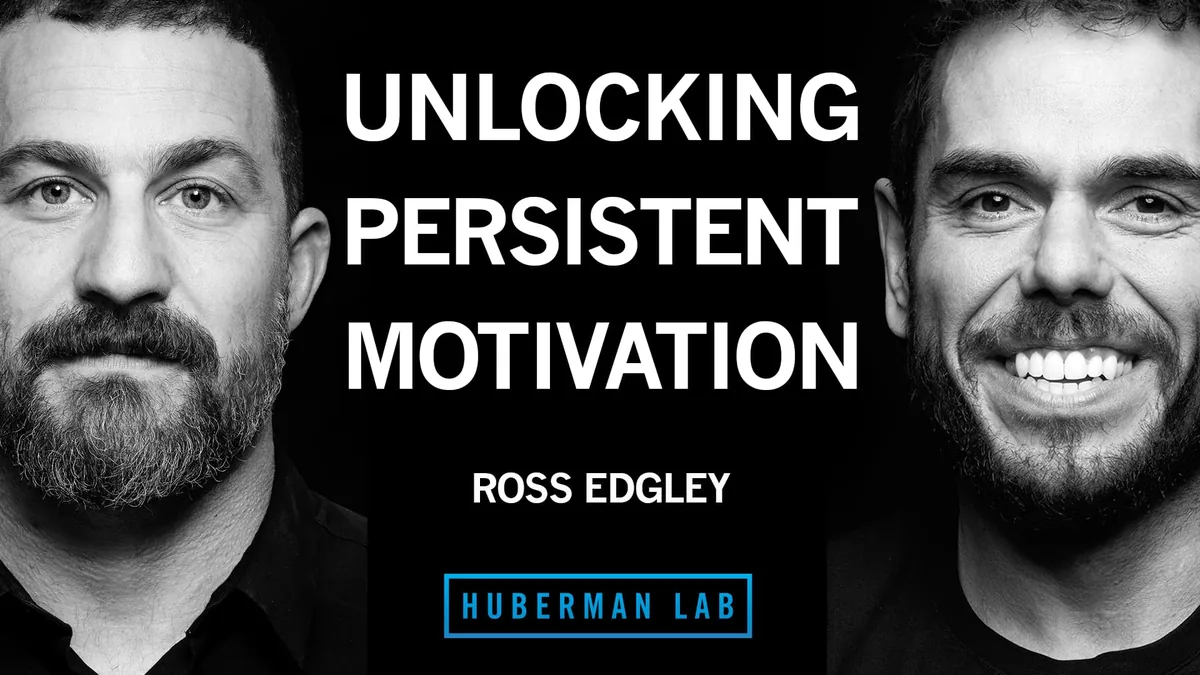
Preview image for Unlocking Persistent Motivation & Extreme Resilience | Ross Edgley
Image: Huberman Lab
podcast2 hr 44 min listenPhysical Activation

Unlocking Persistent Motivation & Extreme Resilience | Ross Edgley

via Huberman Lab

Ultra-endurance swimmer Ross Edgley and Andrew Huberman explore the brain circuits and shifting psychological 'spokes' (purpose, shame, anger, love, money) that drive extreme endurance, drawing on mythology, neuroscience, and Edgley's record swims around Great Britain, Iceland, Loch Ness, and the Yukon River.

  1. Edgley proposes a 'wheel of motivation' with multiple spokes (commitment, shame, anger, love, ego, money) that rotate as one source loses potency.
  2. Huberman explains the anterior mid-cingulate cortex and dorsolateral prefrontal cortex as circuits underlying tenacity, strategy, and persistence under pressure.
  3. Stress inoculation via deliberate cold exposure builds tolerance for panic/adrenaline, but this resilience doesn't fully generalize across unrelated stressors.
  4. Strength training builds connective tissue and 'strength reserve' so swimming strokes use a smaller percentage of max capacity, preventing tendon/ligament failure on ultra-swims.
  5. High-stakes pressure can cause the motor cortex to over-recruit circuitry and 'choke,' while focusing on process rather than outcome prevents this.

“I always say your reasons to continue need to be bigger than your reasons to stop.”

— Ross Edgley
Jump to 5 key moments
  1. 11:51Anterior mid-cingulate cortex and the wheel of motivation
  2. 31:37Dorsolateral prefrontal cortex, persistence and winning
  3. 1:38:28Pain tolerance, stress inoculation, cold exposure
  4. 1:49:38Process vs outcomes, psychological adaptability
  5. 2:11:59Strength training and strength reserve for endurance

Physical activation supports resilience by engaging the neurobiological systems that sustain motivation during difficult tasks. The episode emphasizes perseverance through process, which aligns with using physical practices as a concrete anchor for mental discipline.

Try this week

The article does not provide specific physical activation drills, breath sequences, or somatic practices. A concrete week-long action cannot be derived from this text.

Listen to the full podcast on Huberman Lab →
Preview image for The Science of Doing Your Best Work
Image: Farnam Street
article1 min readMindfulness

The Science of Doing Your Best Work

via Farnam Street

This piece previews a conversation with Steven Kotler, executive director of the Flow Research Collective, on the science of flow states. It covers what triggers flow, how task difficulty affects it, and what frustration signals during learning.

  1. Flow is described as more trainable than most people assume, according to Kotler.
  2. The discussion covers how hard a task should be before it pulls someone into flow.
  3. Frustration during learning is reframed as meaningful signal rather than failure.
  4. The conversation contrasts play with practice and discusses focusing on undesired work.
  5. A longer, extended version with extra content is available to members at fs.blog.

The article discusses flow triggers and learning mechanisms, including how to navigate frustration during skill development. Understanding these flow conditions supports mindfulness by clarifying the mental states and environmental factors that enable sustained, focused attention—a core component of mindful awareness.

Try this week

The article does not provide a concrete mindfulness practice (breathwork, metacognitive protocol, or beginner's mind exercise) that can be implemented this week. A more specific mindfulness resource is needed for actionable practice.

Read the full article on Farnam Street →

Get the next one in your inbox

Free · one email a week · unsubscribe anytime

© 2026 ShapeTheZone LLC. All rights reserved.