Art: a lone tennis player seen from behind in silhouette, racket at the side, standing at the centre of a glowing mandala ring of light on a dark empty court at night

THE ZONE SIGNAL · SIGINT #007

Confidence under pressure

· Curated by The Zone Signal

Art: A hand gripping a golf club, eyes closed, feet slightly apart on a green fairway, with a distant green pin; sunlight creates a halo-like glow around the closed eyes
video16 min watchStress Inoculation

Sian Leah Beilock: Why we choke under pressure -- and how to avoid it

via ted.com

Cognitive scientist Sian Leah Beilock explains why we choke under pressure: overthinking disrupts skills that should run automatically. She offers evidence-based fixes—practicing under stress, distraction techniques, and journaling—plus shows how anxious parents and teachers can transmit performance fears to kids.

  1. Pressure causes "paralysis by analysis": overattention to automatic skills degrades performance, shown in a soccer-dribbling study.
  2. Distraction techniques (singing, focusing on a pinky toe) can unhook the prefrontal cortex from pesky details.
  3. Practicing under realistic, stressful conditions (timed retrieval, audience practice) closes the gap between training and performance.
  4. Jotting down worries before a stressful event reduces intrusive thoughts and improves performance.
  5. Math anxiety is contagious: anxious teachers and parents cause children, especially girls, to learn less; over 90% of US elementary teachers are women.

“When you have to stop and think, that's when you mess up.”

— Tim Duncan

Stress inoculation works by training your nervous system under realistic pressure conditions, which prevents the overattention and 'choking' that occurs when stakes rise. Beilock's research shows that practicing in performance-like situations rewires your response to pressure, allowing you to maintain focus and avoid the paralysis that comes from anxious overthinking.

Try this week

During one practice session this week, deliberately introduce pressure: time yourself, add an audience (even one person), or simulate the real conditions you'll face. When you feel attention narrowing, redirect focus to a simple physical anchor like your breathing or a specific body movement.

Watch the full video on ted.com →
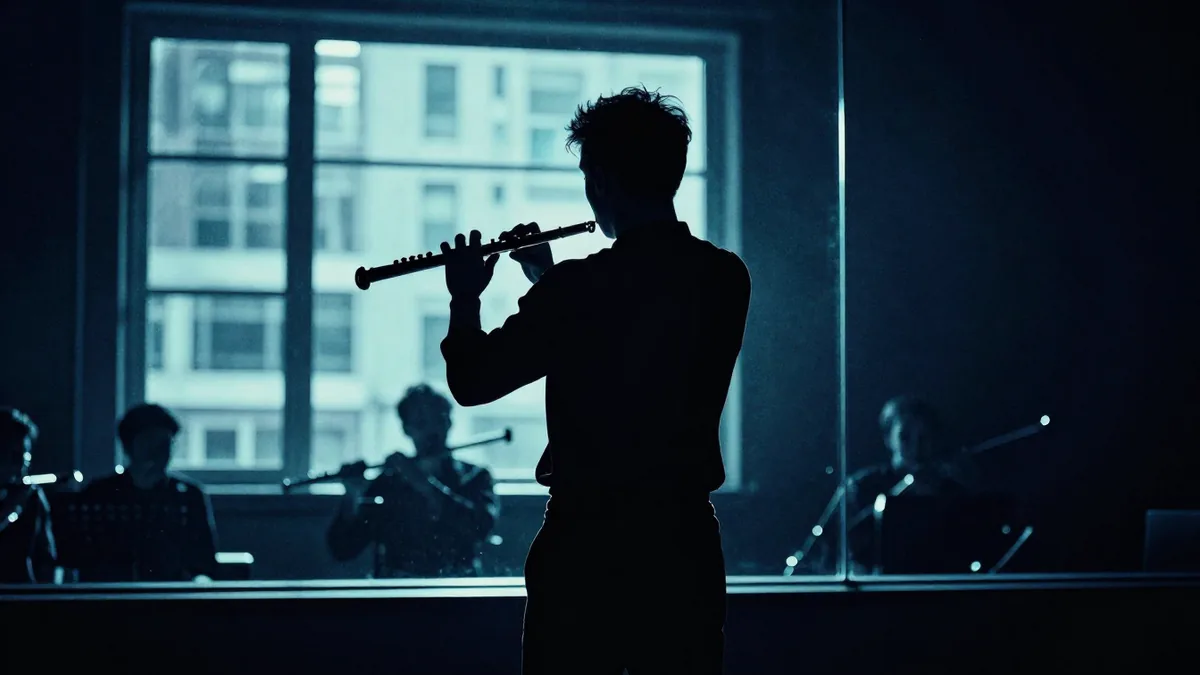
Art: A flutist stands before a mirror, adjusting her embouchure, then steps onto a stage with a hesitant glance, playing a flawless melody with, sunlight filtering through city windows

Lorna Mcghee: Treating Confidence as Something You Do, Not Something You Feel

via The Bulletproof Musician

Boston Symphony principal flutist Lorna McGhee argues confidence is a choice, not a feeling: you can perform well while scared by equipping yourself philosophically, physically, and mentally, choosing courage, and treating technique as removing obstacles to expression rather than chasing perfection.

  1. Confidence is overrated; mantra 'choose courage' and 'it doesn't matter how you feel, it's what you do' (Dana Sinclair).
  2. Alexander Technique is about skill/coordination, not relaxation; freeing the neck redirects tension under pressure.
  3. Practice should be proactive, not reactive: isolate small chunks, keep body peaceful, since whatever you practice you reinforce.
  4. Most auditions end in rejection due to sheer odds, so accept vulnerability, offer your best, and let results not define you.
  5. Before her Boston audition she used a written, timed warmup notebook plus quotes and names of mentors to stay centered.

“Whatever you practice, you reinforce. So the last thing you want to do is keep throwing yourself at that difficult passage with tight hands and expecting a different result.”

— Lorna McGhee
Jump to 5 key moments
  1. 2:02Book line that reframed confidence
  2. 9:30What technical practice is really for
  3. 13:15Rethinking what Alexander Technique is about
  4. 24:00Responding kindly to your own mistakes
  5. 43:00Her written notebook before the Boston audition

McGhee's core thesis—that confidence is something you *do*, not something you *feel*—directly inoculates you against stress by shifting focus from emotional control (which amplifies anxiety) to actionable behavior. This reframing, paired with somatic grounding techniques like body awareness under pressure, trains your nervous system to execute despite discomfort, converting anxiety into usable energy.

Try this week

Identify one high-pressure moment you'll face this week. Before it, commit to a specific pre-performance ritual or body-management action (grounding technique) that you'll execute regardless of how nervous you feel. Focus entirely on *doing* the action, not on achieving a confident feeling state.

Listen to the full podcast on The Bulletproof Musician →
Art: A towering rock face a clear blue sky, a solitary climber in a harness stands at the base, looking up with determined resolve

Build Mental Toughness & Perform Under Pressure | Dr. Lenny Wiersma

via performpodcast.com

This episode features sports psychologist Dr. Lenny Wiersma discussing how elite performers actually handle fear and pressure, using examples like Alex Honnold's free solo climbs and work with MLB players, UFC fighters, and big wave surfers. It challenges the idea that elites simply lack fear.

  1. Honnold's 'no fear' narrative is called academically wrong and unfair to his actual training.
  2. Confidence and belief are treated as distinct concepts, not interchangeable.
  3. The positive/negative self-talk framing is argued to be the wrong lens entirely.
  4. Lenny's 3-2-1 reflection tool is introduced as a practical mental tool.
  5. Emotional control and emotional regulation are presented as critically different concepts.

Stress inoculation builds mental toughness by teaching emotional regulation rather than control—you learn to stabilize your nervous system in high-pressure moments instead of trying to eliminate stress entirely. Dr. Wiersma's work demonstrates this through tools like the 3-2-1 reflection and biofeedback, which help you moderate thoughts and respond effectively under pressure, as shown in elite athletes like Phelps and Honnold.

Try this week

The article mentions the 3-2-1 reflection tool and biofeedback as concrete practices for stress inoculation, but the podcast summary does not provide the step-by-step protocol. You would need to listen to the full episode to extract actionable instructions for implementing these techniques.

Listen to the full podcast on performpodcast.com →
Art: A runner's silhouette in mid-stride on a foggy morning, raindrops glistening on the tense muscles of the athlete's legs and back, a droplet suspended mid-air catching the light

Better By Next Week: Sports Psychologist: "Confidence is a Lie. Competence is Everything." (Daniel Dymond)

via podcasts.apple.com

Performance psychologist Daniel Dymond explains how elite athletes manage anxiety, self-doubt, and pain rather than eliminate them, arguing competence—not fleeting confidence—builds true mental resilience under pressure.

  1. Mindset matters more than state of mind in high-performance psychology work.
  2. Choking under pressure is described as a behavior, not an emotion.
  3. Self-belief comes from competence built through blood, sweat, and effort—not feelings.
  4. Ultra runners can manage nursery-rhyme thoughts and let go of control during multi-day events.
  5. Building a better relationship with anxiety, self-doubt, and pain beats trying to eliminate them.

Stress inoculation works by building a working relationship with anxiety rather than trying to eliminate it—treating discomfort as a trainable state. Dymond's framework of competence over confidence and anxiety as workable directly supports this principle: exposure to uncomfortable states during practice conditions your nervous system to remain stable under pressure.

Try this week

Identify one task where you feel anxious. Instead of avoiding or suppressing the anxiety, notice it present and continue executing the task anyway. Track one instance where you completed the action despite discomfort to build evidence that competence works independent of confidence.

Listen to the full podcast on podcasts.apple.com →
Art: a cricket batter in whites at the crease stadium floodlights, bat grounded, head perfectly still, watching a fast bowler run in across a dark ground
video5 min watchFocus

Noa Kageyama and Pen-Pen Chen: How to stay calm under pressure

via ted.com

Choking under pressure happens when attention breaks down, either through distracting worries overloading working memory or through overanalyzing usually automatic skills. Some people are more prone to it, but practicing under stress, using pre-performance routines, and focusing externally on the goal can reduce it.

  1. Two theories explain choking: distraction (worries compete for mental attention) and explicit monitoring (overanalyzing automatic skills).
  2. A 2004 study found stressed students did worse on complex, memory-intensive math problems but fine on easy ones.
  3. Golfers told to focus on stroke mechanics putted worse than those focused simply on accuracy.
  4. Self-conscious, anxious people more afraid of judgment are more susceptible to choking.
  5. Practicing under stress, using pre-performance routines, and keeping an external focus on the goal improve performance under pressure.

Kageyama and Chen explain that choking under pressure stems from either irrelevant thoughts competing for attention or excessive self-monitoring that disrupts automaticity. Understanding these two mechanisms helps you recognize which pattern affects you, enabling targeted fixes like shifting focus outward to your goal rather than inward to your mechanics.

Try this week

Adopt one pre-performance ritual before a high-stakes moment (presentation, meeting, test). Practice it under mild stress this week to build the routine's stabilizing effect on your focus.

Watch the full video on ted.com →

Get the next one in your inbox

Free · one email a week · unsubscribe anytime

© 2026 ShapeTheZone LLC. All rights reserved.

SigInt #007 — Confidence under pressure · The Zone Signal