
THE ZONE SIGNAL · SIGINT #004

Beginner's mind, on purpose

· Curated by The Zone Signal

Preview image for Only Don't Know
Image: Lion's Roar
article11 min readCognitive Flexibility

Only Don't Know

via Lion's Roar

Judy Roitman, a Kwan Um Zen master and retired mathematics professor, argues that knowing is a construction: categories, perception and language only approximate what is there, and deciding we know something is when we stop looking. Don't-know mind is not vagueness but the open, taking-it-all-in attention we were born with, and the place to rest when stuck.

  1. Conventional knowledge is necessary to function, but we get trapped in it and treat it as the whole of things; its base is inherently unstable.
  2. Perception is constructed: a frog's eye registers movement, not objects, and humans only see a still object because the eyes make tiny constant movements called saccades.
  3. Every 'I know what this is' closes a door. Her example: blue jeans that, enlarged on a phone, turn out to be white, black and indigo threads.
  4. Her practice is huatou: holding a basic question such as 'What is this?' while letting every answer dissolve, going deeper until certainty gives way.
  5. Don't-know mind is a newborn's looking-around attention, no preconceptions and no doors slamming shut: we were born with it, still have it, and can learn to trust it.

“However we thought it was, that’s not how it is.”

— Judy Roitman

Roitman spent a career as a mathematics professor and nearly fifty years in Zen, and her point is not mystical. The feeling of knowing is something we build out of language and habit, and the moment we settle how a thing is, we stop looking at it — in her words, another door slams shut. For a plateaued performer that is the whole diagnosis: you already know how your serve, your bow arm or your opening works, so you have stopped seeing it. Only don't know is the instruction to hold the next rep as an open question rather than a settled fact.

Try this week

Pick the one skill you are surest about. For one session, treat yourself as someone who has never done it: narrate what the body actually does, step by step, as if explaining it to a beginner. Write down one thing you noticed that you knew but had never looked at.

Read the full article on Lion's Roar →
Key points: Why Good Thoughts Block Better Ones
article12 min readFocus

Why Good Thoughts Block Better Ones

via Scientific American

Merim Bilalić and Peter McLeod explain the Einstellung effect: once a familiar solution comes to mind, the brain sticks with it and stops seeing better ones. Eye-tracking of expert chess players shows the first idea steers attention away from the evidence for anything better, even while the player believes they are searching, the mechanism behind confirmation bias and misdiagnosis.

  1. Luchins's 1942 water-jug study: people who learned a three-step method kept using it on a problem with an obvious one-step answer, and gave up when the old method failed.
  2. Chess experts shown a familiar five-move smothered mate alongside a faster three-move mate insisted, after about 37 seconds, that the slow mate was the fastest possible.
  3. The infrared camera showed players who said they were looking for a faster solution never moved their gaze off the squares of the solution they already had.
  4. A 2013 replication (17 novices, 17 experts) found the familiar move trapped both groups when second best; when it was an obvious blunder, every expert found the alternative.
  5. Expertise gives some immunity, but nobody is impervious. The countermeasures: remember you are susceptible, and keep Darwin's memorandum of every fact that contradicts you.

“We may believe that we are thinking in an open-minded way, completely unaware that our brain is selectively directing attention away from aspects of our environment that could inspire new thoughts.”

— Merim Bilalić and Peter McLeod
The Darwin check
  1. Write down the first explanation that comes to mind
  2. Spend five minutes looking only for evidence against it
  3. Keep a running note of what you find

This is the laboratory version of the expert's narrow mind. Chess masters who spotted a familiar five-move mate insisted they were still searching for a faster one; the eye tracker showed their gaze never left the squares of the solution they already had. The familiar idea did not just win, it quietly steered attention away from the evidence for anything better, and it dropped masters to the level of much weaker players. The counter-moves are plain: assume you are susceptible, and keep Darwin's memorandum of the facts that contradict you.

Try this week

In your next review of a performance — video, score sheet, replay — write down the first explanation that comes to mind, then spend five minutes looking only for evidence against it. Keep a running note of what you find. Darwin kept his because contrary facts slipped from memory faster than favourable ones.

Read the full article on Scientific American →
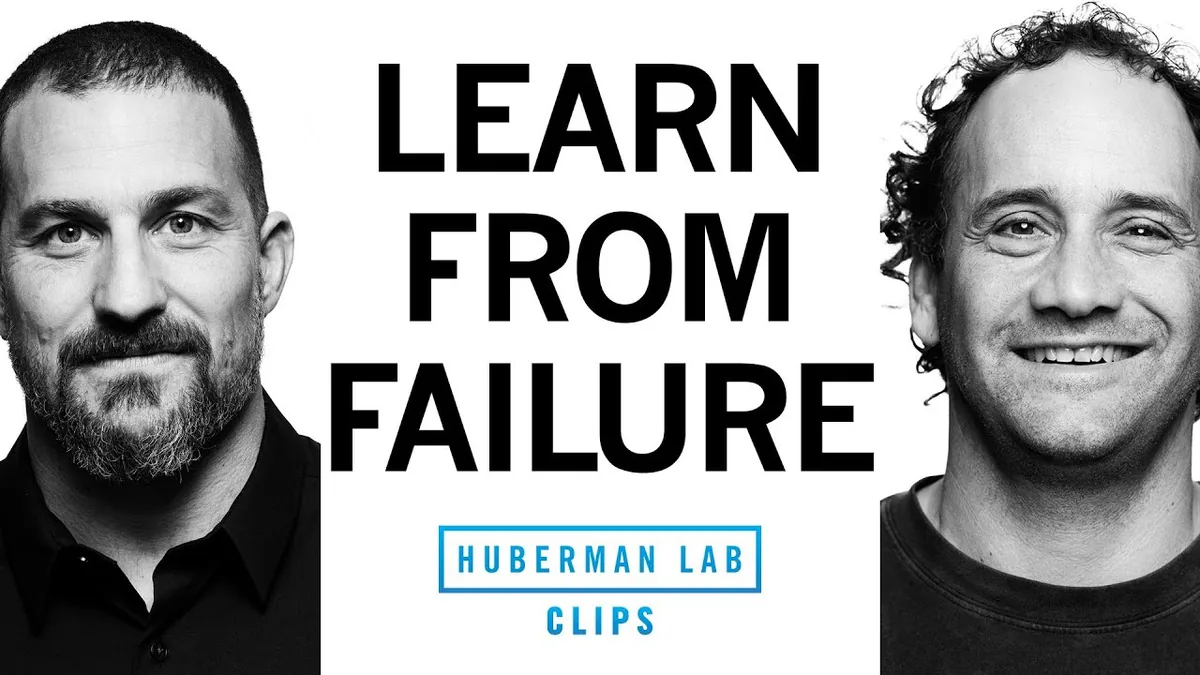
Preview image for How to Use Failure For Change & Growth
Image: Huberman Lab Clips
video12 min watchStress Inoculation

How to Use Failure For Change & Growth

via Huberman Lab Clips

Josh Waitzkin and Andrew Huberman on why failure, not success, drives change. Huberman: the brain only rewires under mismatch and frustration, when adrenaline, noradrenaline and dopamine signal something must change. Waitzkin: losing the Under-18 World Chess Championship final, a game he could not study for two and a half months, whose lesson later won him a martial-arts world title.

  1. Plasticity needs a mismatch: the brain has no reason to change while everything goes right, so frustration and agitation are the chemical signal that learning can begin.
  2. Waitzkin's first national championship loss, at seven, to a boy who became his best friend, stopped him ever associating winning with no pain.
  3. At 17, playing Peter Svidler for the Under-18 world title, he declined a draw in the critical position, played one over-aggressive move and lost.
  4. He could not face studying the game for two and a half months; the winning idea, pulling his last defender away from his own king, was outside his conceptual scheme.
  5. A year later he began Tai Chi push hands, whose essence is using empty space against aggression; in 2004 that principle won him the world championship final.

“the most heartbreaking losses lead to the transformational change which leads to the biggest wins of their life”

— Josh Waitzkin
Jump to 5 key moments
  1. 1:44Failure & Growth
  2. 3:17Losing World Chess Championship
  3. 8:15Studying Failure
  4. 9:27Applying Lessons From Chess to Tai Chi
  5. 10:56The Power of Loss in Achieving Success

Waitzkin's version of beginner's mind is physical. He calls it investment in loss, and this clip is him and Huberman on why the shattering moments did the most for him, and why he counts a foil session with too few falls as one where he did not push the turns hard enough. The humility here is a training variable rather than a virtue: the beginner falls because they are at the edge of what they can do, and staying at that edge is the only place learning happens.

Try this week

Choose one practice this week where you deliberately play above your level — a stronger partner, a faster tempo, a harder passage — and count your failures instead of your successes. Set a floor: if you did not fail at least five times, you were not at the edge.

Watch the full video on Huberman Lab Clips →
Preview image for How to get better at the things you care about
Image: TED
video12 min watchHabits

How to get better at the things you care about

via TED

Eduardo Briceño explains why hard work often stops producing improvement. Effective performers alternate between a learning zone, where the goal is to improve and mistakes are expected, and a performance zone, where the goal is to execute and minimise mistakes. Most of us live almost entirely in the performance zone, which is why professionals plateau within a few years.

  1. Learning zone: work on what you have not mastered and expect mistakes. Performance zone: execute what you have mastered and minimise them. Know which one you are in.
  2. Performance usually plateaus after the first couple of years in a profession — teaching, medicine, nursing — because once we feel adequate we stop entering the learning zone.
  3. Deliberate practice, after Anders Ericsson: break a skill into sub-skills, pick one, work just beyond your current ability with full concentration, frequent feedback and ideally a coach.
  4. Ten to twenty minutes a day typing 10 to 20 percent faster than your reliable speed makes you faster; years of ordinary typing do not.
  5. Beyoncé performs, then reviews the show video in the hotel that night and sends notes next morning. Learning needs low stakes: no new tricks without a net.

“The reason many of us don't improve much despite our hard work is that we tend to spend almost all of our time in the performance zone.”

— Eduardo Briceño
Jump to 5 key moments
  1. 0:58The two zones defined
  2. 3:03Deliberate practice and the two-year plateau
  3. 6:04Beyoncé's nightly learning loop
  4. 6:43Four conditions for the learning zone
  5. 9:10Three moves when the stakes are high
Two zones, chosen on purpose

Learning zone

  • Work on what you have not mastered
  • Expect mistakes, low stakes

Performance zone

  • Execute what you have mastered
  • Minimise mistakes

Briceño's answer to the plateau is structural. Most of us spend nearly all our time in the performance zone — executing what we already do well and minimising mistakes — and almost none in the learning zone, where we work on what we cannot yet do and expect to get it wrong. Effort in the wrong zone does not compound, however hard you work. Beginner's mind, in his framing, is simply choosing the learning zone on purpose, with low stakes, and knowing which zone you are in at any moment.

Try this week

Split one practice this week in two. First half, learning zone only: one sub-skill below your ceiling, slow, with mistakes expected and a way to get feedback. Second half, performance zone: run it as if it counts. Say out loud which zone you are in before each half.

Watch the full video on TED →
Preview image for A Meditation for Overthinking and Perfectionism | Jeff Warren
Image: 10% Happier with Dan Harris
podcast10 min listenMindfulness

A Meditation for Overthinking and Perfectionism | Jeff Warren

via 10% Happier with Dan Harris

A ten-minute guided meditation from Jeff Warren, built on the Zen idea of Don't Know Mind: noticing how the need for certainty — about what is true, what comes next or how things should be — creates tension and overthinking, then practising letting that need go and resting in curiosity and direct experience.

  1. The need to know — certainty about what is true, what is coming next, or how things should be — is framed as the engine of tension, anxiety and overthinking.
  2. The practice is to loosen that grip rather than find better answers: rest in curiosity and openness instead of grasping.
  3. The aim, in the language of the Diamond Sutra, is a mind that dwells nowhere — attention that stays open with nothing pre-decided.

Ten minutes of the thing itself. Warren's practice, drawn from Zen and the Diamond Sutra, is to notice the grip of needing to know — what is true, what comes next, how it should go — and to loosen it, resting in curiosity instead. For a performer the application is the minute before you start, when the mind is busy predicting the outcome. Don't-know mind is not vagueness; it is attention with nothing decided in advance.

Try this week

Run this ten-minute meditation once a day this week, and once right before a session or a game. Afterwards, note in one line what you were trying to know in advance, and whether the first few minutes of play felt different.

Listen to the full podcast on 10% Happier with Dan Harris →

Get the next one in your inbox

Free · one email a week · unsubscribe anytime

© 2026 ShapeTheZone LLC. All rights reserved.

SigInt #004 — Beginner's mind, on purpose · The Zone Signal