
THE ZONE SIGNAL · SIGINT #010

Metacognition: the thought observer

· Curated by The Zone Signal

Preview image for How to rewire your brain — and find your flow | Heather Berlin
Image: TED Talks Daily
video14 min watchMindfulness

How to rewire your brain — and find your flow | Heather Berlin

via TED Talks Daily

Neuroscientist Heather Berlin explains that thriving means balancing the prefrontal cortex (control) with the limbic system (impulse), and offers four practical exercises to practice 'losing control on purpose' to access flow, creativity, and calm.

  1. Four practices: microletting go, leaning into discomfort, finding flow activities, and embracing microboredom
  2. Microletting go: take one small daily risk (30 seconds) like a different route home to build tolerance for imperfection
  3. Exposure to discomfort teaches the brain 'uncomfortable isn't unsafe,' reducing anxiety over repeated practice
  4. Flow is a measurable brain state where self-monitoring recedes and dopamine/norepinephrine rise, sharpening focus
  5. Five minutes of boredom lets the default mode network cross-talk with executive regions, sparking new ideas

“Letting go isn't giving up. It's loosening the reins.”

— Heather Berlin
Jump to 5 key moments
  1. 4:59Practice 1: Microletting go
  2. 6:26Practice 2: Lean into discomfort
  3. 8:25Practice 3: Find your flow activity
  4. 10:22Practice 4: Embrace microboredom
  5. 11:51Acceptance leads to freedom
Four Ways to Lose Control
  1. Microletting go: take one small daily risk, sing or dance badly
  2. Lean into discomfort: plant feet, breathe, say 'this is discomfort not danger'
  3. Find flow: do one activity where you lose track of time
  4. Embrace boredom: five phone-free minutes to let mind wander

Mindfulness involves observing your thoughts and urges without judgment, which Berlin's framework directly supports through metacognition—noticing when your prefrontal cortex (brake) and limbic system (accelerator) are out of balance. This awareness lets you shift mental gears intentionally, moving between control and release rather than getting stuck in reactive patterns.

Try this week

Notice one urge to tighten up during a stressful moment this week. Pause and observe it without acting on it immediately—this is the 'microletting go' Berlin describes. Record what you notice.
Watch the full video on TED Talks Daily →
Preview image for Cognitive Defusion Techniques (ACT, Free PDF)
Image: psychology.com
article9 min readCognitive Flexibility

Cognitive Defusion Techniques (ACT, Free PDF)

via psychology.com

This piece explains cognitive defusion, an ACT skill for noticing thoughts as passing mental events rather than literal truths, and offers a free printable with techniques like 'I'm having the thought that...' It distinguishes defusion from CBT's thought-challenging and from thought-stopping, and notes defusion is a daily coping skill, not a stand-alone treatment for severe conditions.

  1. A meta-analysis found ACT performs about as well as established treatments like CBT across mental and physical health conditions.
  2. Masuda and colleagues found repeating a word reduced discomfort and believability versus distraction and thought control conditions.
  3. The Cognitive Fusion Questionnaire links higher fusion with thoughts to more anxiety and depression symptoms.
  4. Thought stopping can backfire and make unwanted thoughts more frequent, unlike defusion.
  5. The 'milk, milk, milk' technique involves repeating a harsh word aloud for thirty seconds until it becomes just a sound.
I'm Having The Thought That
  1. Take the sticky thought, e.g. 'I'm going to mess this up.'
  2. Restate it as 'I'm having the thought that I'm going to mess this up.'
  3. Add another layer: 'I notice I'm having the thought that...'
  4. Notice the small space that opens up between you and the thought.

Cognitive defusion teaches you to observe your thoughts as mental events rather than facts, which creates distance between you and automatic reactions. This awareness is a prerequisite for cognitive flexibility—noticing what you're thinking allows you to recognize when a strategy isn't working and consider switching approaches without being trapped by rigid thought patterns.

Try this week

Pick one defusion technique from the article (such as repeating a worried thought aloud until it loses meaning) and apply it when you notice a repetitive thought blocking your performance. Observe whether creating that distance helps you access alternative responses.

Read the full article on psychology.com →
Key points: BI 107 Steve Fleming: Know Thyself

BI 107 Steve Fleming: Know Thyself

via braininspired.co

This episode discusses Steve Fleming's book Know Thyself, covering the science of metacognition and self-awareness. Topics include brain mechanisms, computational models, evolutionary origins, animal metacognition, and the prospects of building self-aware AI.

  1. Covers brain mechanisms and computational models underlying metacognitive behavior.
  2. Explores evolutionary and cultural origins of self-awareness.
  3. Examines which animals beyond humans show metacognition and how to test it.
  4. Discusses metacognition's role in theory of mind and social interaction.
  5. Considers how metacognitive skill develops over a lifetime and relates to other traits.
Jump to 5 key moments
  1. 3:25Steve's Career
  2. 30:56Evolutionary cultural origins of self-awareness
  3. 45:02Animal metacognition
  4. 1:08:56Reliance on AI
  5. 1:15:15Building self-aware AI

The episode discusses metacognition—observing your own thinking—which is essential for noticing when you're caught in overconfidence, mind-wandering, or rigid strategies during performance. Awareness of your own mental state is the first step to changing it mid-performance.

Try this week

After each practice session or game this week, rate how confident you felt about your three biggest decisions, from 1 to 5, then check each rating against what actually happened. The places where confidence and result disagree are where your read on your own thinking needs work.

Listen to the full podcast on braininspired.co →
Preview image for Frontiers | Thinking and Action: A Cognitive Perspective on Self-Regulation during Endurance Performance
Image: frontiersin.org
article23 min readCognitive Flexibility

Frontiers | Thinking and Action: A Cognitive Perspective on Self-Regulation during Endurance Performance

via frontiersin.org

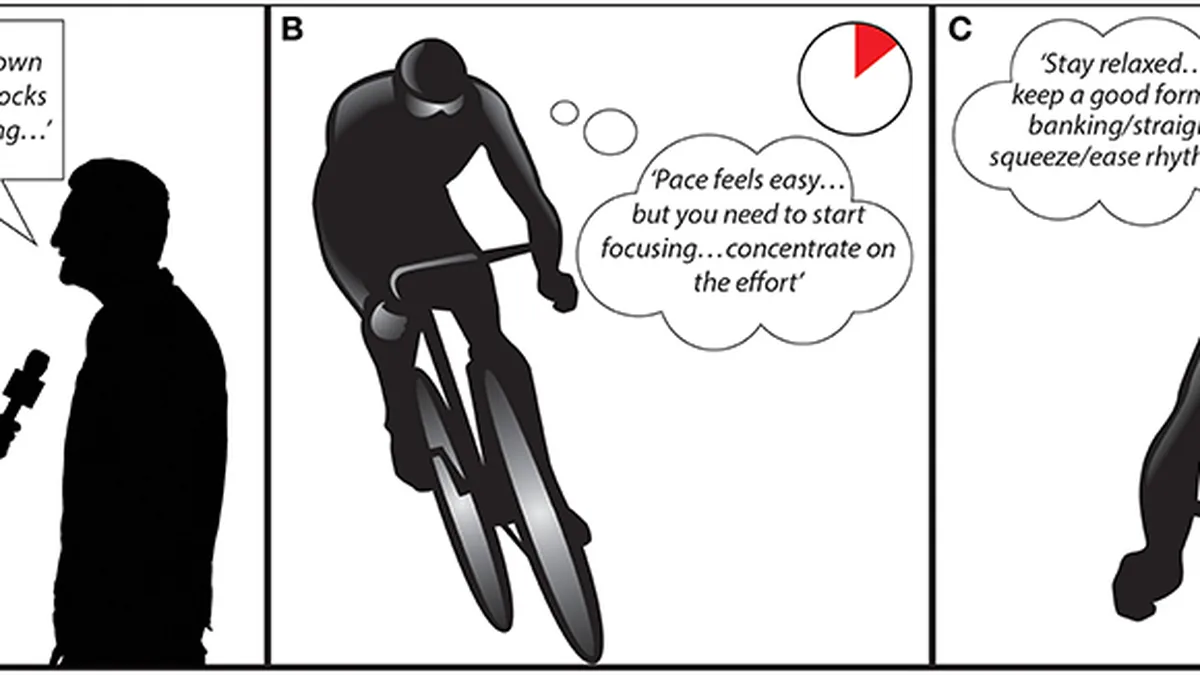
This review argues that effective pacing in endurance sport depends on cognitive and metacognitive self-regulation, not just physiology. Attentional focus shapes effort perception and performance, and athletes must blend proactive (goal-driven) and reactive (stimulus-driven) cognitive control. The framework is illustrated using Bradley Wiggins' 2015 Hour record, showing planning, monitoring, and strategy shifts during the ride.

  1. Focusing on technique, cadence, or relaxing can optimize pacing without raising perceived effort.
  2. Excessive focus on bodily sensations worsens effort perception; distraction reduces effort but can slow pace.
  3. In a 3km trial, externally-paced runners showed 2% lower heart rate than self-paced runners, reflecting reactive control.
  4. Wiggins planned a 16.1s/lap pace, 105rpm cadence, and chunked the Hour into 12-minute blocks beforehand.
  5. Mid-ride, Wiggins recalculated to 16.4s/lap after unexpected air pressure, preserving goal commitment and positive affect.

“In the Hour, you carry any mistakes with you until the end, so pacing is everything”

— Chris Boardman

Cognitive flexibility during endurance performance depends on your ability to shift between proactive control (planning your effort ahead) and reactive control (adjusting to unexpected fatigue or conditions). Metacognition—thinking about your own thinking—helps you notice when you're locked into one mental strategy and consciously switch to another when circumstances demand it.

Try this week

Before your next long session, split it into blocks (Wiggins used 12-minute blocks) and pick one cue for each: relax, rhythm or technique. At the end of every block, check your pace against the plan. If conditions have changed, adjust the target the way Wiggins did rather than abandoning it.

Read the full article on frontiersin.org →

Frontiers | Meditating musicians: investigating the experience of music students and professional musicians in a brief mindfulness course to address music performance anxiety

via frontiersin.org

Mindfulness meditation reduces music performance anxiety by training meta-awareness—the ability to observe your own thoughts and mental patterns during performance. This heightened self-awareness helps musicians recognize anxiety triggers and respond more skillfully rather than being overwhelmed by performance stress.

Try this week

Before your next rehearsal or performance, sit for five minutes with your attention on your breath. Each time a worry about the performance shows up, label it "thinking" and return to the breath. When nerves rise mid-session, use the same label once and carry on.

Read the full article on frontiersin.org →

Get the next one in your inbox

Free · one email a week · unsubscribe anytime

© 2026 ShapeTheZone LLC. All rights reserved.

SigInt #010 — Metacognition: the thought observer · The Zone Signal